The comparison below is from my original review. Since then:
- Anan: Thetis has advanced quite a bit, with many new features. The WDSP library from Warren Pratt has been greatly enhanced, adding the incredible NNR noise reduction algorithm, a big leap ahead even over NR2 which was industry leading. The biggest leap has been https://zeussdr.com/, which is now cross platform and runs on Windows, Mac and Linux. I'm running Zeus on the Anan from a Mac Studio M2 Max the majority of the time.
- Sun: EESDR3 has also advanced, with lots of bug fixes and enhancements to its noise reduction, greatly improving its effectiveness. I've just switched the Sun to be my digital modes radio.
- Verdict: the Anan has the most powerful and high quality transmit audio there is, period. The Sun can sound fantastic, but the Anan and its software is the king. You wouldn't hate the Sun if you've not had an SDR transceiver, but if I had to buy just one radio it would be something in the family of ZeusSDR, Hermes Lite 2 on a budget or one of the Anan/Apache Labs radios. The tipping point for me is cross platform software of several kinds now available for them, and the audio quality on TX and RX is unsurpassed.
Original review (2022): feature comparison and notes
Features won in my original 2022 comparison. The highlighted cell marks the winner of each row.
| Feature | Anan 7000 DLE mkII | SunSDR2 DX |
|---|---|---|
| Number of ADCs | 2 | 1 |
| Audio Processing Capability | Extensive | Extensive |
| Bands of Coverage and Power Level | HF–6 m @ 100 W | HF @ 100 W, 6 m @ 50 W, 2 m @ 8 W |
| Sampling Rate/Spectrum Size | 1.5 MHz | 382 kHz |
| Diversity Receive | Yes | No |
| Operating System Support | Windows only | Windows, Linux, macOS |
| Virtual Audio Cable Support tie | Yes | Yes |
| Digital Mode Operations tie | Yes | Yes |
| Modern software architecture | No | Yes |
| Community/User Supported | Yes | Yes |
| Overall Value for the Money | Exceptional | Very good |
| Balanced line level inputs | No (unbalanced line input) | No (needs a pad) |
| Noise Reduction | NR2 + Diversity | DSP NR |
| Adaptive pre-distortion (PureSignal) | Yes | No |
Notes by feature
Number of ADCsEdge: Anan
- Anan 7000 DLE mkII
- 2
- SunSDR2 DX
- 1
Two ADCs permit for duplex operations and assignment to two antennas for simultaneous receiving on different bands. I don't use this feature the way I operate but many may find it important.
Audio Processing CapabilityEdge: Anan
- Anan 7000 DLE mkII
- Extensive
- SunSDR2 DX
- Extensive
Both radio software packages offer extensive audio processing capability to include levelers, limiters, compressors, powerful EQ. The Anan has the edge. Both radios have different tools and they take some practice to learn to apply the suite that each offers. I can get them both to sound quite good.
Using the Yaesu pinned RJ-45 microphone connector on the Sun I'm able to make the throwaway Yaesu MH-31 hand microphone sound very good. It's incredible what you can do with either rig if you take the time to learn your way with the capability.
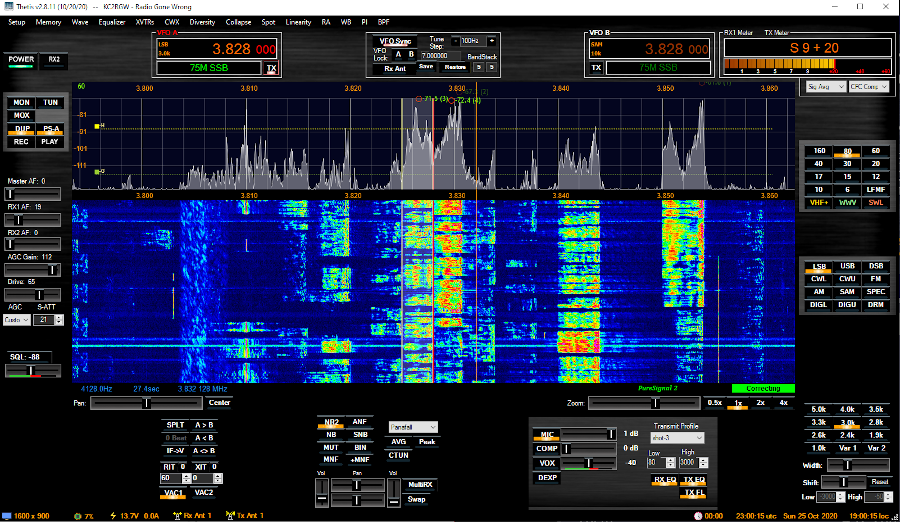
The Anan is the winner here, the CFC is just so effective that I have not been able to achieve the same level of audio power the Anan produces with ExpertSDR2. The CFC is a multi-band compressor with definable frequency bands. In addition the ALC system in Thetis in combination with the CFC creates the most powerful audio possible without introducing any significant IMD due to Pure Signal.
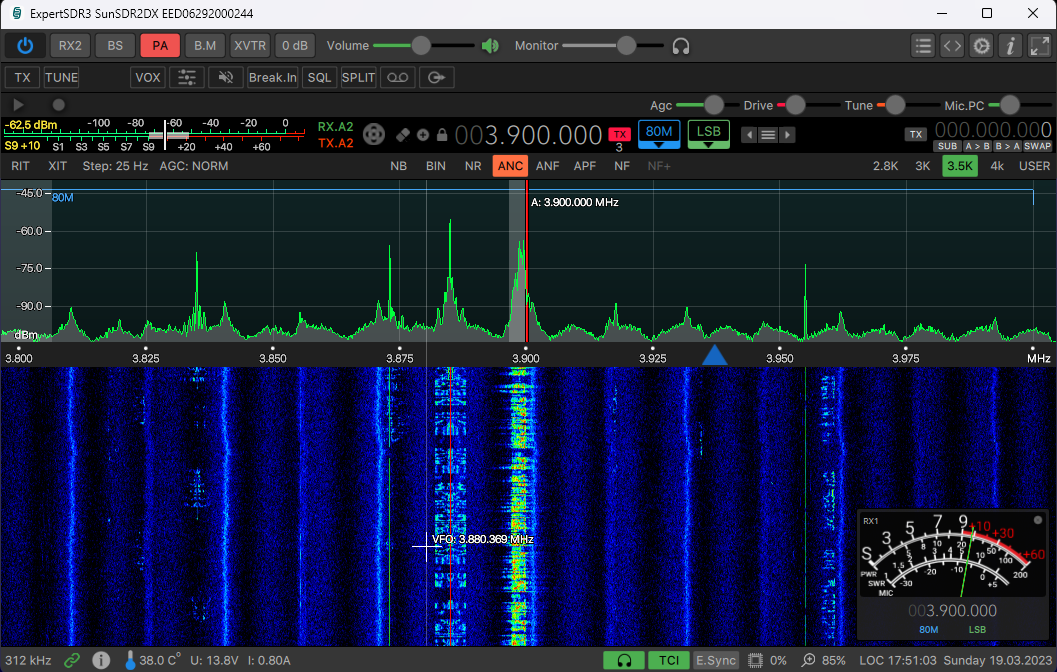
The audio system in EESDR3 has been improved, the tools enhanced and the ALC response, so now the audio power is more comparable than it was in the V2 software I originally compared.
Bands of Coverage and Power LevelEdge: SunSDR2 DX
- Anan 7000 DLE mkII
- HF-6m @ 100W
- SunSDR2 DX
- HF @ 100W
6m @ 50W
2m @ 8W
Having the VHF capability is a handy advantage and the SunSDR2 has enough drive power for using an amplifier
Sampling Rate/Spectrum SizeEdge: Anan
- Anan 7000 DLE mkII
- 1.5 MHz variable down from there
- SunSDR2 DX
- 382 kHz maximum for main receivers with a wide RX at 67 MHz
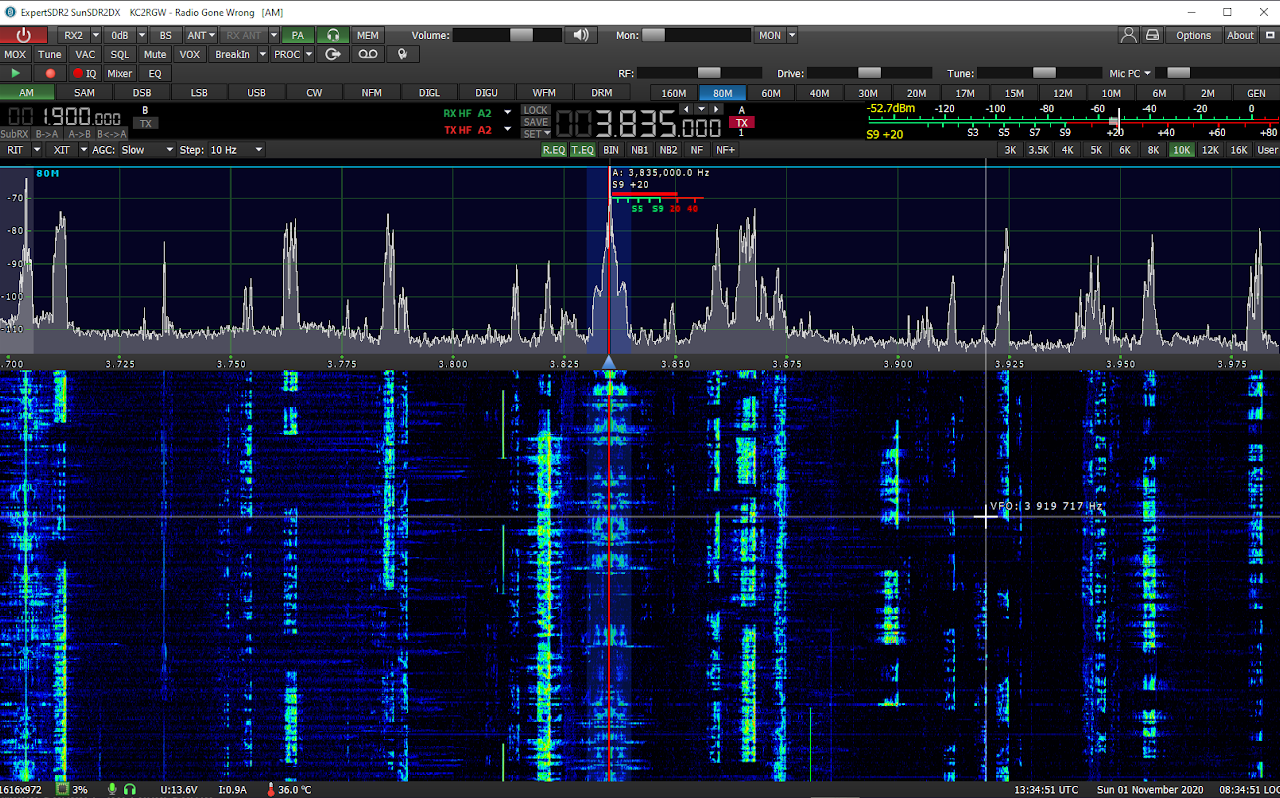
The Anan wins in this area however 382 kHz for me is plenty wide enough for the way I operate and it provides enough resolution for more than adequate filtering and a solid view of the spectrum and waterfall
Diversity ReceiveEdge: Anan
- Anan 7000 DLE mkII
- Yes
- SunSDR2 DX
- No
Having the second ADC permits Diversity reception which I use effectively for phase cancelling locally generated man made noise. This is one pain point where the Anan wins as I can null my electric heat pump or other periodic noise sources (my washing machine) when needed.
Operating System SupportEdge: SunSDR2 DX
- Anan 7000 DLE mkII
- Windows only (There is a linux software offering but it is not currently maintained and does not support the full capability of the hardware and it is not built in a distribution package at all so it requires constant recompiling and maintenance)
- SunSDR2 DX
- Windows, Linux, macOS
This is a huge reason I picked up the SunSDR2 DX. It has linux support. I really dislike running Windows and normally only run a linux desktop and have done so for many years. It is a constant source of irritation to have to run Windows and deal with all of its glitches and the fact it is a black box when troubleshooting issues. The SunSDR2 DX has been running rock solid on Ubuntu 20.04 LTS here, fewer glitches than the Thetis software with the Anan and far easier to monitor and troubleshoot if any issue arises.
Windows, Linux, macOS
ZeusSDR now runs the Anan on Windows, Mac and Linux, which takes away the Sun's biggest advantage here.
Virtual Audio Cable SupportTie
- Anan 7000 DLE mkII
- Yes
- SunSDR2 DX
- Yes
Recent changes made to Thetis have made this a closer race, where Thetis when using ASIO actually has better flexibility with sample rate and buffer size. EESDR3 currently supports 48 kHz sample rate only due to a limitation with the Qt libraries that will be addressed in time.
Digital Mode OperationsTie
- Anan 7000 DLE mkII
- Yes
- SunSDR2 DX
- Yes
They both do it well once you get them set up and configured. If you only do FT8, the Sun has the edge by using TCI that is not only CAT but also audio, it's a network protocol that makes integration with some digimode, logging software and amplifiers very simple.
Modern software architectureEdge: SunSDR2 DX
- Anan 7000 DLE mkII
- No
- SunSDR2 DX
- Yes
PowerSDR and Thetis are Open Source software which is a great advantage in many ways and originally why I purchased the Anan. However the base of the software is built on ancient Windows software stacks that are just a mess to try and modify unless you have a ton of background in that platform.
ExpertSDR2 (soon to be a full rewrite to v3) is done in Qt which makes it portable across operating systems. The software is not open source but it is a more modern architecture and looks and runs more smoothly than the Windows 9x era design of PowerSDR and Thetis.
The risk of the closed software is simply that if Expert Electronics folds or struggles the software may die and without it, one will own a pricy brick of electronic components that won't run anymore. With the Open Source Thetis the software code will live on and it's a separate entity from Apache Labs who simply are a hardware manufacturer that the open source software supports. The project is based on Open HPSDR and TAPR.
Community/User SupportedEdge: Anan
- Anan 7000 DLE mkII
- Yes
- SunSDR2 DX
- Yes
Due to simply a longer lifetime of the software and more radios sold, there is more information out there on the Anan/PowerSDR/Thetis combo. This is important for people who are not used to being tenacious researchers or may not be very driven or adventurous to really hammer through any issues or learning new software.
The user guides for the ExpertSDR2 software (SunSDR) are not bad but they have some small omissions or assumptions here and there that require a bit of prior understanding of SDR software or transceivers to skip over. Once baseline configured I think the software is more intuitive to use, however that initial step is a bit of a big one for people completely new to this experience.
Overall Value for the MoneyEdge: Anan
- Anan 7000 DLE mkII
- Exceptional
- SunSDR2 DX
- Very Good
The Anan wins in the overall hardware spec. It's simply a more powerful design and for the money well out specs some far more expensive rigs on the market. However, day to day use, not in an isotropic laboratory, my experience is that these two radios are very very close to a point where I personally cannot choose a winner in this category.
I think they are both a fair value for the price and considering the user experience with ExpertSDR2 it pulls the SunSDR2 up a few notches for overall value. If the same level of work on software was applied to the Anan, particularly if the FPGA was properly leveraged to its true potential, the Anan would just crush the SunSDR2, however the SunSDR2 is maximizing the performance of the platform on which it is built.
The software lets the Anan hardware down.
Balanced line level inputsEdge: Anan
- Anan 7000 DLE mkII
- No but has a line level input for rack gear.
- SunSDR2 DX
- No and no line level input, you will need a pad to bring it to mic level.
Neither rig has a balanced line level input. The Anan has a line level input but it is unbalanced and the SunSDR2 requires balanced to unbalanced as well as a pad to use line level analog audio input. In my opinion it is better with both, more convenient, to simply use a USB interface and VAC as the audio path.
The ExpertSDR2 software for the Sun has much better handling of using VAC path for microphone audio, it doesn't limit your mode of operation with multiple receivers where Thetis/PowerSDR have a very unusual way of handling it where it's not really meant for microphone audio and really designed purely for digital software use...clunky.
Noise ReductionEdge: Anan
- Anan 7000 DLE mkII
- Advanced NR2 and Diversity
- SunSDR2 DX
- Has DSP NR
Here is where the Anan really shines. The Diversity capability allows me to phase cancel some very high output local sources of noise here at my house. My electric heat pump, my washer and a few others that pop up can be significantly dropped by phasing a short dipole hanging in my shack against the RX signal. Additionally, though the NR on the SunSDR DX works ok, certainly better than my TS-590SG, the NR2 in particular that the Anan has simply outclasses it.
The EESDR3 has ANC that has been greatly improved. I am uncertain but I believe it is a machine learning voice filter that recognizes voice over noise.
It works particularly well on signals that have a good SNR, not as great on weak signals (for phone). With the improvements to ANC it's a closer race, but NR2 still wins in my opinion.
Adaptive pre-distortion (PureSignal)Edge: Anan
- Anan 7000 DLE mkII
- Yes
- SunSDR2 DX
- No
Due to having two ADCs the Anan can implement adaptive pre-distortion. Though the Sun has a quite clean signal, the Anan tops it with higher IMD suppression. Due to how the audio is processed in ExpertSDR2 in order to try and approach the audio power of Thetis/PowerSDRmrx you can wind up raising IMD as you try to get enough audio drive power out with the SunSDR2 DX.
The over drive issues in v2 have been greatly mitigated in EESDR3, it is very clean without any pre-distortion in play. Most people don't need anything more for ham use.
Source: the original comparison spreadsheet.
So, is there a winner?
People will ask which one “wins”? This is tough to call. Taking the capability to run in linux out of the comparison, the Anan becomes a clear winner to me. Had I not had the Anan to compare with, if the SunSDR2 DX was my first SDR, I would be very happy with it.
The hardware spec of the Anan wins, as it should for the added cost but the software is not making full use of the hardware potential. The missing link is that the project is open source and to make the improvements needed, FPGA firmware programming expertise is needed.
This is a very specialized area and super rare to find someone who understands it, who is a ham operator, who owns an Anan, and who wants to contribute for free to an open source project. The likelihood this situation changes is very remote.
To clarify this issue. It is simpler to find people to program in the application/PC software stacks than in the FPGA domain. What this means is that a lot of the FFT processing is done in the Thetis/PowerSDR software. This leaves a lot of the potential of the Altera Cyclone IV just lying on the table.
It is less efficient to do, though current compute horsepower allows for it to be possible, though at higher latency and requiring vastly more bandwidth on the link between the radio hardware and the software stack. This introduces the issue where the Gigabit ethernet link needs to be just pristine or the software will glitch causing operational issues.
The SunSDR uses 100 Mbit ethernet and it is a more reliable link because there is a less critical data going back and forth over that link.
The reason that Flex has been able to make remoting so efficient is that they have put most of the computation into the FPGA and this means that the software is just a control surface with far less data needed to translate over a remote control link. The Anan could be in the same situation... if the right expertise was applied to the firmware architecture.
For my own use, though this is still the shiny initial impression stage, I'm pleased with the SunSDR2 DX and due to my desire to operate in linux all the time, this may tip the scales. I will be awaiting the somewhat delayed debut of the ExpertSDR v3 software which is a total redesign and rewrite. If the redesign fills in a few voids, particularly in the audio processing, it may narrow the gap.
Nits To Pick or Wish List Items
Anan 7000 DLE mkII
- Runs and really depends on Windows. I dislike Windows for many reasons
- The handling of VAC, it's not a good user experience if you feed a microphone in via VAC, it's meant as the dedicated mode for digital mode use so you lose some basic controls oriented to operating phone with VAC audio as the source. You lose independent RX volume control and mic level controls.
- The amount of shuffling to go between phone and digital modes, again if you use VAC for a microphone. There's clunkiness to change the Audio settings for the device to use for digital too, buffer size etc.
- BNC connectors. I've just never liked how they just wobble all around without a good feel if they are solidly terminated. I hate that if you gently wobble them you can see variations. Low confidence in them.
- A balanced line level input would be nice
SunSDR2 DX
- The NR algorithm needs to be enhanced (default settings are poor but works better once you adjust Rate and Leak in the DSP tab). Works better than the lousy NR in a Kenwood TS-590SG but nowhere near NR2 in Thetis (the best I've ever used by far) or NR4 in SDR Console.
- Lack of Diversity which I use heavily for noise suppression. With a single hardware ADC, I'm not sure this can be addressed without a new hardware design.
- The default RX filters are fixed values in the software presets. I prefer to customize them as I like a 0 Hz low cut when using 3 kHz and wider RX modes which is common for me. The RX filters should be memory settable. A width and shift slider for digital modes would be a huge improvement too though memory settings for RX filters tied to the mode of operation would settle that issue.
- I wish the TX bandwidth was saved with the Proc profile vs the global as I have to do the global for some components and then remember to check the Proc profile as that isn't tied to the global. The reason is, let's say I have MyMic1 microphone that I want to run 3.5 kHz wide, I want the Proc profile to be equalized for that passband specifically as it does change and the TX width to be 3.5. It requires two stages of toggling. Proc profile should also change a TX width.
- The power output on HF isn't really 100W, it's more like 70W. I don't miss the watts but it is sold as a 100W rig. Unsure if maybe a quality control issue with bias levels or something like that.
- A balanced line level input would be nice
- There is a known software issue with the transmit buffer whereby after sending a Tune tone, the following key up will transmit about 1.5s of that tone before the stale buffer is flushed.
- There is a known firmware issue where using the hardware PTT (as opposed to software controls for PTT) when released will release before the transmit buffer has flushed. Simply, a PTT hardware switch will drop close to 1s of the last part of the signal sent...it clips off parts of words. You have to mentally pause and say "and" to yourself before releasing the PTT switch or you will lose the tail of what you said.
The points that give the win to the Anan at this point
- The NR2 is just amazing, best NR algorithm I've ever used second only to SDR Console's options after spending time to manually tweak them as a close 2nd runner up.
- Diversity for noise cancellation - It can mean armchair quality vs very ragged copy in many cases.
- The receiver just seems hotter, I have an easier time with very poor signals when going A/B between the Anan and the Sun, but it's close.
- The audio processing still wins, the multi-frequency compressor is extremely effective once one gets their head around what is happening and how to apply it. The Sun can sound excellent but the sheer audio power of the Anan makes it conspicuous when friends who know the difference hear it. I can get them both to sound nearly identical to someone hearing me very strong but the density of the signal is higher with the Anan and people in the distance can pick it out right away.
- The SAM sync detector is hugely faster to slew on the Anan so if you are in a fast break-in AM discussion with people +/- 3 kHz with old rigs involved, the Anan snaps to them where the Sun can not keep up with the frequency shift and you lose people on short transmissions as it tries to find their carrier.
- These points all make for more comfortable copy and as I am primarily a rag chewer on SSB and AM, they are meaningful to me.
ExpertSDR v3: the total re-write of the software for the Sun SDR rigs (July 2022)
- The software for the Sun is undergoing a complete overhaul. This includes new firmware architecture and the whole code base of the main user interface.
- The re-write allows them to keep firmware much more independent from the main software core release. This means that changing operating characteristics in one software package that runs cross platform makes things much simpler. One release, serves linux, Mac and Windows and it functions identically across the platforms. Previously the software was tied to the model of radio AND the OS it was compiled for, this is far more complex and more prone to inconsistencies with the releases.
- The interface is using Qt6 which itself is being rapidly developed. It's an efficient, cross platform toolkit that supports more complex software applications more easily than other frameworks. It has a slick, clean, modern appearance.
- Many improvements are being made. AGC behavior is vastly improved, the audio limiting and processing systems have had significant work. As one small example, you have to try really hard to force this radio into a truly dirty signal, particularly via virtual audio (you can still clip the hardware op-amp on the analog mic level inputs).
- The newly introduced ANC noise filter is using a sophisticated speech pattern based filter, a neural network and in the right conditions it's pretty remarkable.
- It's running relatively solid for me on Win 10 x64 and Ubuntu 22.04 LTS and I default to running EESDRv3 as my daily software at this point.
- It is still very alpha software, getting closer to what I would consider a beta release. Anyone running it must understand that there are frequent bugs that come and go with each of the releases and take appropriate care and caution when running it.
- A 1.0 release will likely be out in a few more months (it's Jul 2022 right now). For non-technical users, I would wait for that point before running V3 vs V2.
- The enhancements of this new re-write take the Sun up a notch and make it yet more appealing, though the "race" is closer, if running on Windows is not a deal breaker, the Anan + Thetis is still ahead by a length.